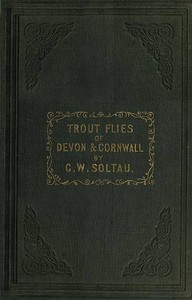
Soltau's 1847 treatise opens with a clear practical aim: to supply the novice angler with a list of flies proven effective over twenty years on Devon and Cornish rivers. He explicitly restricts his remarks to fly-fishing, which he considers the most skilful method, and declines to vouch for his flies' success beyond the West Country, though he suggests they may work in Somerset, smaller Welsh rivers, and some Irish lakes.
The book's structure reflects its dual purpose: part instructional manual for beginners, part regional fly catalog. Soltau includes a note on the difficulty of colouring lithographed plates accurately, advising readers to obtain patterns from makers rather than rely solely on the drawings. This attention to the gap between representation and reality recurs throughout the text.
Regional Specificity and the Limits of Generalization
Soltau repeatedly grounds his advice in local conditions. He notes that Devon and Cornish rivers are very rapid, causing insects to be carried swiftly downstream, so a fish may seize only one fly while others pass by. In more tranquil rivers, he claims, a fly seldom escapes. This observation directly shapes his fly selection and casting recommendations.
The author also reports that trout in these streams rarely exceed a pound, attributing this to the rapid water. Yet he cites his own experience of trout placed in a pond increasing from eight to ten ounces to one to one and a half pounds in a year, suggesting that environment, not genetics, limits size. Such local knowledge is the book's core strength, but Soltau is careful not to overextend his claims, leaving others to test his flies' wider application.
Evidence from Experiments and Anecdotes
Soltau supplements personal experience with external evidence. He describes a feeding experiment with trout in three tanks: one fed worms, another minnows, and a third water flies. The fly-fed trout grew to prodigious dimensions, weighing twice as much as the others combined, though they ate less. This quantitative detail is unusual for an 1847 angling manual.
He also cites a writer in the New Sporting Magazine (1840) on trout growth rates, and mentions a trout of seventeen pounds caught near Great Driffield, and a twenty-five-pound trout taken from a ten-foot-wide stream in Salisbury. These anecdotes serve to illustrate potential size, but Soltau does not claim such fish are common in Devon and Cornwall.
Practical Instructions and the White Moth
The manual includes specific fishing techniques, such as using a white moth fly after sunset in July and August, on fine moonlit nights. Soltau advises choosing an open place on a tranquil portion of the river, noting that the fly may be thrown with less nicety than in daytime and that catching a fish does not alarm neighbouring fry. This level of detail—time of year, time of day, moon phase, casting precision—characterizes the book's approach.
Soltau also addresses the problem of fly patterns not matching the lithographed drawings, recommending that readers obtain physical patterns from makers. This pragmatic concession acknowledges the limitations of printed illustrations and underscores the book's function as a practical guide rather than a theoretical treatise.
Soltau's manual is best read as a period artifact of regional angling knowledge, not a universal guide. Readers interested in the history of fly-fishing or the natural history of Devon and Cornwall will find its local observations valuable. The book's reliance on personal testimony and contemporary experiments offers a window into mid-nineteenth-century angling science, but its claims should be weighed against modern understanding of trout biology and river ecology.
Years at this desk have taught me that patient books collect quiet companions. The 1847 angling manual on Devon trout flies, with its careful observations of a river's shifting surface, seems to share a shelf-soul with The Book of Shells Containing the Classes Mollusca, Conchifera, Cirrhipeda, Annulata, and Crustacea — Edition Insights—both bent over small, glistening things, content to be studied slowly.