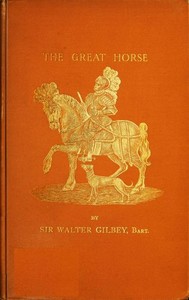
Sir Walter Gilbey opens his 1899 second edition by noting that since the first edition a decade earlier, 'great progress has been made in the improvement of the Shire Horse.' The book is a compact compilation of notes from an inquiry into the antecedents of the Shire-bred horse, leading Gilbey to conclude that the Shire is 'the purest survival of the type described by mediæval writers as the Great Horse.' He traces this type back to the ancient British war horse that 'evoked the admiration of Julius Cæsar.'
Gilbey's method is evidentiary: he examines royal seals, coins, paintings, and correspondence. For instance, he reproduces detailed descriptions of the Great Seal of Charles I, noting the horse's 'tail is in three distinct waves' and the caparison's 'thistles and roses placed alternately.' He also quotes a 1643 letter from Oliver Cromwell offering '60 pieces for that Black you won at Horncastle,' using such documents to argue that the term 'Black Horse' became synonymous with 'Great Horse' during the Commonwealth period.
Seals as Evidence of Type
Gilbey relies heavily on medieval and early modern seals to establish the physical continuity of the Great Horse. He describes the Great Seal of Charles I in minute detail: the king gallops left in complete armour, 'the helmet open showing the features very characteristically rendered,' holding a sword that 'passes above the helmet.' The horse is unarmoured, with a small square saddle cloth. Below the horse, a view of London shows 'the river Thames and London Bridge,' with shipping visible between the hind legs. Gilbey notes that from 1200 onward, 'very many seals have borne the device of a horse, and invariably one of the Great Horse type.' This claim is central to his argument that the breed maintained a consistent form across centuries.
The Black Horse and Cromwell's Correspondence
Gilbey uses a 1643 letter from Oliver Cromwell to Auditor Squire to illustrate both terminology and cost. Cromwell writes: 'Buy those horses, but do not give more than 18 or 20 pieces each for them, that is enough for Dragooners. I will give you 60 pieces for that Black you won at Horncastle, for my son has a mind to him.' Gilbey interprets this as evidence that 'Black Horse' was used synonymously with 'Great Horse' from about this period. He contrasts the 'dragooners'—lighter horses for men in leather jerkins—with the heavier charger depicted in Vandyke's equestrian portrait of Cromwell, which 'has all the Great Horse character.' The price differential (18-20 pieces vs. 60 pieces) underscores the value placed on the larger breed.
From War Horse to Shire: The Nineteenth-Century Shift
The final chapters document the transformation of the Great Horse from a military animal to a farm breed. Gilbey notes that 'great progress has been made in the improvement of the Shire Horse' since 1889, and his preface to the second edition aims to 'remodel and enlarge' the earlier work with 'more minute details.' He includes a chapter titled 'How to Preserve its Character' and another on 'The Foreign Market,' indicating that by the 1890s the Shire was an export commodity. The book's illustrations—such as the 'Armour Clad German Knight of the 15th or 16th Century' after Hans Burgkmair—visually link the medieval war horse to the modern Shire, reinforcing Gilbey's thesis of unbroken lineage.
Diction and Descriptive Precision
Gilbey's prose is exact and unadorned, reflecting his method as a compiler of evidence. He describes a seal's 'field diapered with interlacing ovals, in which appear roses and thistles alternately,' and notes that 'the legend begins with a rose, which is repeated between the words.' His descriptions of paintings are similarly precise: Vandyke's Cromwell shows 'the Protector, partially clad in armour,' on a charger with 'all the Great Horse character.' Gilbey avoids hyperbole; his claims are hedged with phrases like 'it is altogether improbable' and 'stress must be laid on the fact.' This restraint lends credibility to his argument, even when the evidence is circumstantial.
Gilbey's book is best read as a curated dossier rather than a narrative history. He explicitly states that he offers no information that 'those who are interested in the subject may not, with an equal amount of patient reading obtain for themselves.' Readers should approach the text as a series of documented observations—seal descriptions, painting analyses, and transcribed letters—that together build a case for the Shire horse's ancient pedigree. The value lies not in sweeping conclusions but in the specific, tangible details Gilbey has gathered.
Flipping through Gilbey's Great Horse, I kept noticing how patiently he watches the noble warhorse become a ploughman's partner. Something in his quiet attention to that slow transformation reminds me of an old friend's copy of Studies in the Art of Rat-catching — Key Ideas to Explore, where every small, cunning detail is given the same grave courtesy. Odd, how both books honor creatures doing unglamorous work.