About 95 minutes
Everglades Wildguide Handbook 143 — Reading Notes
Gardening
21,680 recorded words. 0 minutes difference from this book's estimate.
View Gutenberg source #54970
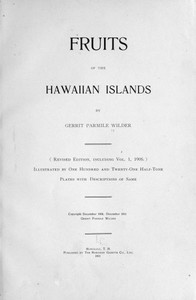
The catalog record for Fruits of the Hawaiian Islands — Story, Setting & Ideas provides practical reading context through 21,800 words, 1 hr 35 min estimated reading time, and 6 detected text sections.
The text analysis averages about 15.1 words per sentence, while the detected sections provide another way to judge how the source is divided.
Project Gutenberg metadata also associates the work with “Fruit-culture -- Hawaii,” connecting these edition facts with the source record’s subject description.
Explore this collection
These alternatives are selected using recorded categories and estimated reading time.
About 95 minutes
Gardening
21,680 recorded words. 0 minutes difference from this book's estimate.
View Gutenberg source #54970About 97 minutes
Gardening
22,250 recorded words. 2 minutes difference from this book's estimate.
View Gutenberg source #3452About 99 minutes
Gardening
22,603 recorded words. 4 minutes difference from this book's estimate.
View Gutenberg source #33679Search stored excerpts and compare books → Choose by your preferences →
Choices use stored catalog measurements. Estimates vary with reading speed. A shared category is a catalog label, not a claim that two books have the same argument or literary quality.
Search reads excerpt text stored with this catalog and links to its associated Gutenberg record. The connection is stored in the site database; this tool does not recheck that every excerpt is word-for-word identical to that external record. Excerpt search does not cover every chapter and does not verify historical publication dates.
Catalog snapshot checked: 2026-09-25. Coverage: 98 public books, 98 available source excerpts.
Read the complete public-domain text at its original source.
Read on Project GutenbergGerrit Parmile Wilder's Fruits of the Hawaiian Islands (revised edition, 1911) opens with a detailed index listing over seventy species, from avocado to banana, each keyed to a half-tone plate. The work is a systematic botanical catalog, not a narrative or travelogue. Wilder, a Honolulu-based horticulturist, organizes entries by scientific name, common name, and plate number, then provides concise descriptions of growth habit, leaf shape, flower structure, fruit characteristics, and propagation. The preface and copyright page establish the book as a revised edition incorporating volume 1 of 1906, published by the Hawaiian Gazette Company.
The book's index reveals a deliberate arrangement: entries follow a consistent pattern—scientific name, common name, plate reference, then descriptive text. Wilder covers both introduced and native species, such as the avocado (Persea gratissima) with three plates, and the endemic Vaccinium reticulatum (Ohelo). The inclusion of coffee (Coffea arabica and C. liberica) and ornamentals like banana indicates a broad definition of 'fruit' that includes economically important plants. Each entry typically notes origin, cultivation history, and local Hawaiian names or uses, as seen with the 'Noni' (Morinda citrifolia), whose seeds 'will float a great length of time in salt water.'
Wilder blends scientific description with observations from Hawaiian horticulture. For the banana, he notes that 'about fifty varieties were known to the older natives' but that the Chinese banana introduced in 1855 'has crowded out the native varieties, many of which are now extinct.' This remark, grounded in local history, appears without editorializing. Similarly, the Ohelo entry states it 'has always been a favorite subject of Hawaiian songs and legends' and 'was used as one of the offerings to the Goddess Pele.' Such cultural notes are woven into botanical facts, not separated into a thematic section. The text also includes practical propagation advice, as for banana: 'Propagation is by off-shoots or suckers.'
Each entry references a half-tone plate, and the excerpts include captions such as 'Plate LXVII. — Banana —" Maia. " One half natural size.' The plates are integral: they depict fruit and sometimes foliage at natural size or reduced scale, with labels like 'Moa Largo Popoulu Red Cuban Lele Chinese G. P. W. Collection.' Wilder's collection is credited, suggesting he supplied specimens. The visual documentation complements the text, allowing readers to compare varieties. For the currant tomato, the plate shows '100 to 40 small, currant-like red berries'—a rare numerical detail that hints at the precision of the illustrations.
Wilder frequently situates species within Hawaiian geography and ecology. The Ohelo 'thrives best in the higher elevations, from 4000 to 8000 feet' and 'grows particularly well on the mountain slopes of Hawaii and Maui.' He notes its role as 'the principal food of the rare Hawaiian goose.' The 'Popolo' (Solanum nodiflorum) is described as 'common to most tropical countries, and in Hawaii was probably of aboriginal introduction.' These details, drawn from observation and local knowledge, give the catalog a regional specificity. The book does not claim completeness; rather, it presents a snapshot of early 20th-century Hawaiian fruit cultivation, with species already in decline.
Readers approaching Fruits of the Hawaiian Islands should treat it as a reference work best consulted entry by entry, not read straight through. The plates and descriptions reward comparison across species. Wilder's quiet documentation of extinct or declining varieties—like the native bananas—adds historical weight. For gardeners or botanists interested in Pacific horticulture, this book offers a precise, period-specific record of what was grown and valued in Hawaii a century ago.
I kept thinking about Wilder’s Hawaiian fruit book long after closing it—the way a single breadfruit tree can hold an entire island’s memory. It made me wonder about other fruits carrying quieter histories. So I found myself with The Almond in California — Background and Themes, and it lingers the same way, gently. Some books just sit with you, unhurried, like old friends.
Use these questions to collect your thoughts before moving on.