About 32 minutes
Guidebook of Palo Duro Canyon — Reading Notes
Gardening
7,351 recorded words. 0 minutes difference from this book's estimate.
View Gutenberg source #50487
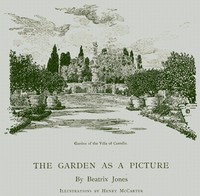
This digital edition of The garden as a picture — Inside the Classic is described by source-level measurements including 7,231 words, 32 min estimated reading time, and 2 detected text sections.
The text analysis averages about 31.7 words per sentence, while the detected sections provide another way to judge how the source is divided.
Project Gutenberg metadata also associates the work with “Landscape gardening,” connecting these edition facts with the source record’s subject description.
Explore this collection
These alternatives are selected using recorded categories and estimated reading time.
About 32 minutes
Gardening
7,351 recorded words. 0 minutes difference from this book's estimate.
View Gutenberg source #50487About 32 minutes
Gardening
7,175 recorded words. 0 minutes difference from this book's estimate.
View Gutenberg source #76015About 31 minutes
Gardening
7,106 recorded words. 1 minutes difference from this book's estimate.
View Gutenberg source #19038Search stored excerpts and compare books → Choose by your preferences →
Choices use stored catalog measurements. Estimates vary with reading speed. A shared category is a catalog label, not a claim that two books have the same argument or literary quality.
Search reads excerpt text stored with this catalog and links to its associated Gutenberg record. The connection is stored in the site database; this tool does not recheck that every excerpt is word-for-word identical to that external record. Excerpt search does not cover every chapter and does not verify historical publication dates.
Catalog snapshot checked: 2026-09-25. Coverage: 98 public books, 98 available source excerpts.
Read the complete public-domain text at its original source.
Read on Project GutenbergBeatrix Farrand opens her essay by positioning garden design as a fine art, directly comparing the gardener's work to that of a painter. She writes that plants are to the gardener what his palette is to a painter, establishing a central metaphor that runs through the entire piece. Farrand immediately distinguishes the landscape gardener's challenge: unlike a painter, who works on a flat surface with a fixed viewpoint, the gardener must compose with real color, line, and perspective, subject to changing light and multiple viewing angles. She notes that the gardener has no noncommittal canvas at the back of his picture, but must be prepared for criticism from any standpoint, a constraint that shapes every design decision.
Farrand insists that a garden maker must know intimately the form and texture as well as the color of all the plants he uses. This knowledge is not botanical trivia but the practical equivalent of a painter understanding his pigments. She argues that plants are only one of the tools, although one of the most important, with which a garden is made. The designer must consider how each plant contributes to the overall composition, much as a painter selects colors for a canvas. Farrand warns against relying on bedding plants of atrocious color, comparing a kaleidoscope unfavorably to Quakerish restraint. Her language is precise: she speaks of the fanfare of yellows and scarlets, suggesting that some gardens may benefit from omitting such bold notes in favor of subtler harmonies.
One of Farrand's most striking observations is that shadow is a color and must be used as one. She credits the impressionist school for teaching this lesson, and applies it directly to garden design. She describes how the eye seeks relief from a flat surface not only from monotony but from the need for shadow. Farrand illustrates this with the example of a flat country like Holland, made beautiful by cloud shadows passing over it. She notes the beauty of outline of tree shadows thrown on a lawn by the later afternoon sun, distinguishing the gracious curves of round-topped trees from the pointed ones that seem stretched out to hurry on the dusk. This attention to the quality of shadow reveals her painterly eye and her insistence that gardens are dynamic compositions shaped by light.
Farrand devotes careful attention to how a garden changes at different times of day, particularly at dusk. She describes how the scheme changes as yellow daylight fades, taking with it the subtler colors and leaving only whites and some yellows to prevail. The elimination of detail at night and the thick quality of the light alter the apparent distance of colors entirely, giving a curiously submerged appearance to the garden. She advises that if a garden will be looked at often from the house on hot summer nights, the designer may wish to get the peculiar floating effect of certain white flowers which seem to quiver in the air rather than to grow on stems. This passage shows Farrand thinking like a painter of nocturnes, attuned to the specific visual phenomena of twilight.
Farrand concludes with a call to attentive observation. She urges people not to hesitate to make gardens because the difficulties seem too great; it is only by having them, living in them, and never ceasing to notice the changes that are constantly passing over them that they will learn to see. She lists specific details to notice: the different lights and shadows, the plants whose scent begins at dusk, the sounds of leaves on different sorts of trees—the rippling of the poplar, the rustling of oak-leaves in winter, the swishing of evergreens. The owner of a garden, she writes, is like the leader of an orchestra; he must know which instruments to encourage and which to restrain. This metaphor reinforces her view of gardening as a compositional art requiring constant adjustment and sensitivity.
Farrand's essay is a concise manifesto for the garden as a pictorial composition, grounded in her own experience as a landscape architect. She offers no step-by-step instructions but rather a way of seeing: a discipline of noticing light, shadow, color, and texture as they shift through the day and seasons. Readers interested in the intersection of art and horticulture will find here a clear, opinionated voice that treats garden design as a serious aesthetic practice, demanding both technical knowledge and an artist's eye.
Reading Beatrix Farrand’s insistence that a garden is a living picture, I found myself drifting to an old friend, A Garden Diary, September 1899—September 1900 — Story, Setting & Ideas. There is a quieter honesty in its pages, a sense of watching seasons settle rather than compose. Farrand speaks of painterly control; that diary murmurs of patience. Both linger in my mind like light on a familiar border, one teaching me to see, the other simply letting me remember. A Garden Diary, September 1899—September 1900 — Story, Setting & Ideas feels like a whispered echo of that same green thought.
A brief reflection can help important ideas stay with you longer.