About 32 minutes
Guidebook of Palo Duro Canyon — Reading Notes
Gardening
7,351 recorded words. 0 minutes difference from this book's estimate.
View Gutenberg source #50487
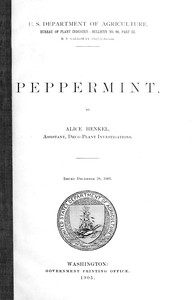
For Peppermint — Reading Companion, the stored edition analysis reports 7,175 words, 32 min estimated reading time, and 13 detected text sections.
The text analysis averages about 21.4 words per sentence, while the detected sections provide another way to judge how the source is divided.
Project Gutenberg metadata also associates the work with “Peppermint,” connecting these edition facts with the source record’s subject description.
Explore this collection
These alternatives are selected using recorded categories and estimated reading time.
About 32 minutes
Gardening
7,351 recorded words. 0 minutes difference from this book's estimate.
View Gutenberg source #50487About 32 minutes
Gardening
7,231 recorded words. 0 minutes difference from this book's estimate.
View Gutenberg source #69479About 31 minutes
Gardening
7,106 recorded words. 1 minutes difference from this book's estimate.
View Gutenberg source #19038Search stored excerpts and compare books → Choose by your preferences →
Choices use stored catalog measurements. Estimates vary with reading speed. A shared category is a catalog label, not a claim that two books have the same argument or literary quality.
Search reads excerpt text stored with this catalog and links to its associated Gutenberg record. The connection is stored in the site database; this tool does not recheck that every excerpt is word-for-word identical to that external record. Excerpt search does not cover every chapter and does not verify historical publication dates.
Catalog snapshot checked: 2026-09-25. Coverage: 98 public books, 98 available source excerpts.
Read the complete public-domain text at its original source.
Read on Project GutenbergAlice Henkel’s 1905 bulletin for the U.S. Department of Agriculture treats peppermint as both a botanical subject and an agricultural commodity. The text opens with precise botanical description—square stems, lance-shaped leaves, purplish flowers in terminal spikes—then immediately pivots to economic concerns: yields, export values, and the threat of adulteration. Henkel distinguishes three mint varieties by stem color, leaf shape, and hardiness, noting that black mint is “much more hardy and productive” than white mint, yet its oil is “more pungent and less agreeable.” This tension between hardiness and quality recurs throughout the bulletin, shaping its practical advice for growers.
Henkel describes three cultivated mints: American mint (Mentha piperita), black mint (M. piperita vulgaris), and white mint (M. piperita officinalis). The distinctions are visual and economic. Black mint has purple stems and dark-green leaves; white mint has green stems and brighter, more deeply toothed leaves. Black mint yields more oil and is hardier, but its oil is coarser. White mint produces a finer oil but is less productive. The American mint, naturalized from England, occupies a middle ground. Henkel’s language is clinical—she notes that black mint is “grown on” (the excerpt cuts off) but the pattern is clear: each variety represents a compromise between yield and quality, a theme that shapes the bulletin’s recommendations.
The bulletin explains that peppermint oil is obtained by steam distillation, with a still illustrated in figure 3. Henkel then turns to the oil’s uses: as a stimulant, carminative, and flavoring. She introduces a key concern: adulteration. Japanese oil, derived from a different species, is “very inferior,” with an “unpleasant odor” and “bitter, disagreeable taste,” yet it contains more menthol and is cheaper. This makes it a likely adulterant of true peppermint oil. Henkel also distinguishes American menthol, or “pipmenthol,” from Japanese menthol by odor. The passage reveals a market where purity is precarious, and the grower must guard against substitution.
Henkel includes two tables: one showing 1904 exports by country, another tracking annual exports from 1895 to 1904. In 1904, Germany imported 22,372 pounds, the United Kingdom 11,558 pounds—together over three-quarters of total exports. The ten-year table shows dramatic swings: from 162,492 pounds in 1897 down to 13,033 pounds in 1903, then up to 42,939 in 1904. Values fluctuate even more sharply, from $257,484 in 1897 to $34,943 in 1903. Henkel does not explain these shifts, but the data imply a volatile market. The tables, drawn from government commerce reports, ground the bulletin in empirical trade statistics, reinforcing its dual identity as botanical guide and economic report.
Henkel’s bulletin is best read as a document of its time: a government publication aimed at improving agricultural practice through science and data. Readers interested in the intersection of botany and commerce will find a concise case study in how a single crop’s varieties, cultivation methods, and market forces interact. The excerpts leave questions unanswered—how did growers respond to adulteration? What drove the export swings?—but the text provides a solid foundation for exploring those questions further.
Reading Peppermint — Reading Companion, with its careful notes on steam and grading, reminded me of how quietly a place can hold a craft. There is a similar unhurried patience in Amid the High Hills — Inside the Classic, where the land itself seems to breathe through every page. Both feel like old, sun-warmed records of work and weather.
Use these questions to collect your thoughts before moving on.