About 226 minutes
Every woman her own flower gardener — A Closer Reading
Gardening
51,812 recorded words. 0 minutes difference from this book's estimate.
View Gutenberg source #76043
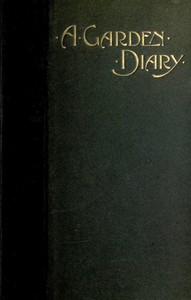
For A Garden Diary, September 1899—September 1900 — Story, Setting & Ideas, the stored edition analysis reports 51,763 words, 3 hr 46 min estimated reading time, and 5 detected text sections.
The text analysis averages about 25.1 words per sentence, while the detected sections provide another way to judge how the source is divided.
Project Gutenberg metadata also associates the work with “Gardening,” connecting these edition facts with the source record’s subject description.
Explore this collection
These alternatives are selected using recorded categories and estimated reading time.
About 226 minutes
Gardening
51,812 recorded words. 0 minutes difference from this book's estimate.
View Gutenberg source #76043About 227 minutes
Gardening
52,110 recorded words. 1 minutes difference from this book's estimate.
View Gutenberg source #63104About 223 minutes
Gardening
51,243 recorded words. 3 minutes difference from this book's estimate.
View Gutenberg source #44738Search stored excerpts and compare books → Choose by your preferences →
Choices use stored catalog measurements. Estimates vary with reading speed. A shared category is a catalog label, not a claim that two books have the same argument or literary quality.
Search reads excerpt text stored with this catalog and links to its associated Gutenberg record. The connection is stored in the site database; this tool does not recheck that every excerpt is word-for-word identical to that external record. Excerpt search does not cover every chapter and does not verify historical publication dates.
Catalog snapshot checked: 2026-09-25. Coverage: 98 public books, 98 available source excerpts.
Read the complete public-domain text at its original source.
Read on Project GutenbergEmily Lawless opens her garden diary not with a description of blooms or weather, but with a confession of thwarted ambition. She recalls a youthful dream of becoming a heroic traveller, a discoverer of undescribed forms—only to acknowledge that fate confined her to a garden chair. This tension between wanderlust and rootedness sets the tone for the entire work. Lawless writes that we learn to 'grow down gracefully, as the sedums and the pennyworts do,' a botanical metaphor for accepting a narrower lot in life. The diary thus becomes a record not just of plants, but of a mind that has turned its exploratory energy inward, finding in a single garden the equivalent of Amazonian forests.
Lawless explicitly frames gardening as a substitute for exploration. She notes that if she has not 'thridded Amazonian forests' with Mr. Bates or 'Nicaraguan jungles' with Mr. Belt, she can access their experiences by taking down their books. This intellectual travel is a recurring motif: the garden becomes a microcosm of the wider world, and the gardener a vicarious adventurer. The diary's opening pages establish a persona that is self-deprecating yet proud, aware of its limitations but defiantly claiming the 'vital part' of exploration as its own. Lawless's voice is conversational, laced with irony, as she measures her life against the heroic scale she once imagined.
One of the most vivid passages describes an overwhelming profusion of Verbascum olympicum—'bright yellow giants' that reach eight feet in height. Lawless counts one hundred and eleven in flower at once, creating a 'congregation of the giants' that shoulder each other and appear unexpectedly in corners of the copse. She compares them to 'lemon-coated attendants' standing at attention, a comic image that deflates their grandeur. The evening primrose (Œnothera Lamarckiana) receives similar treatment: it is 'too good-natured, and too vigorous,' threatening to people the neighbourhood with its descendants. Lawless's tone mixes admiration with exasperation, capturing the gardener's perennial struggle with abundance.
Lawless reflects on the life cycle of biennials, noting that Verbascum olympicum may take three years to flower, after which it dies, leaving a 'black stump' that is both ugly and difficult to remove. This observation leads to a practical lament: 'When are we to possess a really good perennial foxglove I wonder?' The diary here reveals a gardener's long view—the patience required to wait for blooms, the frustration of gaps left by dying plants, and the constant negotiation with nature's timing. Lawless's prose is precise and unsentimental, grounded in the physical realities of digging, planting, and clearing.
Lawless's diary is best read as a meditation on scale—the small scale of a garden set against the large scale of youthful dreams. Her observations are rooted in specific plants and their behaviors, but they continually open onto wider reflections on ambition, mortality, and the quiet comedy of gardening. Readers will find not a practical manual but a literary work that uses the garden as a lens for self-examination. The diary rewards those who appreciate wit, botanical detail, and the subtle art of growing down gracefully.
The rain kept time with Lawless’s mulleins, their slow, stubborn rise against my window. I thought of her worn hands measuring autumn’s quiet, and somehow that led to ledgers of wheat and barley, to prices inked during the same wet seasons. Her garden was a small accounting. Agricultural prices — Inside the Classic felt like the other side of that same ledger, all earth and numbers, no flowers left to spoil.
Create a short personal record of your experience with this book.