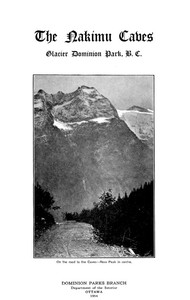
The Nakimu Caves pamphlet opens by situating the caves near the summit of the Selkirk range, calling them “one of the most curious series of subterranean caves in the world.” The text immediately establishes a tension between inaccessibility and government-led development: the caves were “almost inaccessible except to the most agile and daring,” yet a road and trail were being built to connect them to the railway hotel at Glacier. This dual focus—on the rugged, natural wonder and on the infrastructure to tame it—shapes the entire work.
A Hanging Valley and Its Approach
The pamphlet devotes considerable space to the valley of Cougar Creek, describing it as a “hanging valley” carved by glacial erosion into a U-shaped cross-section, distinct from the V-shape produced by water alone. This geological detail is not mere background; it explains the cave formation and the dramatic scenery. Wheeler’s quoted description emphasizes “colour contrasts” of snow, rock, glacier ice, and pine forest, with “magic lakes of changing shades of blue and green.” The approach to the caves is presented as an attraction in itself, with alpine flora noted as unusually abundant. The journey, by saddle pony and then on foot, takes about five hours from the hotel, a fact that underscores the remoteness the road project aims to overcome.
Descent into the Pit and the Main Passage
The narrative of entering the caves begins with a descent into a chamber called the Pit, where a “queer slab of rock” shaped like a monumental tombstone bears a carved cross. This striking image is one of several human-like or symbolic forms the text notes. From the Pit, the main passage drops 120 to 130 feet via two routes: the main way and the Marbleway. The walls are water-worn, evidence of a former stream that now flows underground. At the meeting of these ways, two passages diverge: the Slanting Way, formed by separated limestone strata, and the Subway, an arched passage so low that one must “bend nearly double.” The text emphasizes the physical difficulty of traversing these routes, with narrow squeezes and broken debris.
The Art Gallery and Carbonate Formations
Near the south end of the Slanting Way, the pamphlet describes a spot named the Art Gallery, where the walls and floor are covered with a “light creamy colour” incrustation of carbonate of lime, shading to “delicate salmon.” The formation resembles “cauliflower heads set closely together,” a simile borrowed from Ayres’ report. The text notes that similar decorations appear throughout the caves but are most extensive here. It also mentions “rock-milk” (agaric mineral) on floors and boulders, and observes that stalactites are rare—the longest only 15 inches, clear and brittle as glass. This precise, almost taxonomic attention to mineral deposits reflects the pamphlet’s dual role as scientific report and promotional guide.
Sounds and Subterranean Water
Throughout the cave descriptions, sound plays a prominent role. In the Slanting Way, deep cracks in the strata allow the echo of Cougar Creek to be heard “loudly through the vaulted ways.” Stones dropped into these cracks “rebound for a long time before resting.” At the Turbine, water-spouts rush out “with great force and a noise resembling that produced by water falling into the pit of a turbine.” These auditory details—echoes, rebounds, roaring water—create a sense of the cave as a living, resonant space. The text also notes that the stream now carries only meltwater, having found a new subterranean course, a reminder of the dynamic geological processes still at work.
Readers should approach this pamphlet as a hybrid document: part government report, part travelogue, part geological survey. It rewards attention to the interplay of scientific observation and aesthetic appreciation, especially in the descriptions of mineral formations and the physical challenges of the cave. The text’s structure—moving from valley to entrance to specific chambers—mirrors the journey it describes, making it a useful guide for anyone interested in early 20th-century exploration of Canadian natural wonders.
There is something enduring about far-flung caves, how they hold their secrets against the cold. The old Nakimu pamphlet, with its damp pages and hand-drawn maps, always felt like a private letter from the mountains. For quieter kinship, my shelf keeps a copy of Cave Regions of the Ozarks and Black Hills — Background and Themes, a gentle companion in limestone, speaking the same patient language of stone and stillness.