About 57 minutes
The Nakimu Caves, Glacier Dominion Park, B. C. — Inside the Classic
Gardening
13,016 recorded words. 2 minutes difference from this book's estimate.
View Gutenberg source #51042
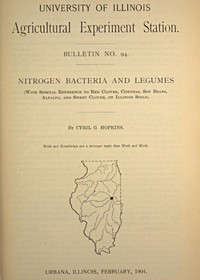
For Nitrogen Bacteria and Legumes With special reference to red clover, cowpeas, soy beans, alfalfa, and sweet clover, on Illinois soils — Background and Themes, the stored edition analysis reports 12,435 words, 55 min estimated reading time, and 2 detected text sections.
The text analysis averages about 25.4 words per sentence, while the detected sections provide another way to judge how the source is divided.
Project Gutenberg metadata also associates the work with “Nitrogen-fixing microorganisms,” connecting these edition facts with the source record’s subject description.
Explore this collection
These alternatives are selected using recorded categories and estimated reading time.
About 57 minutes
Gardening
13,016 recorded words. 2 minutes difference from this book's estimate.
View Gutenberg source #51042About 51 minutes
Gardening
11,575 recorded words. 4 minutes difference from this book's estimate.
View Gutenberg source #42559About 49 minutes
Gardening
11,206 recorded words. 6 minutes difference from this book's estimate.
View Gutenberg source #66012Search stored excerpts and compare books → Choose by your preferences →
Choices use stored catalog measurements. Estimates vary with reading speed. A shared category is a catalog label, not a claim that two books have the same argument or literary quality.
Search reads excerpt text stored with this catalog and links to its associated Gutenberg record. The connection is stored in the site database; this tool does not recheck that every excerpt is word-for-word identical to that external record. Excerpt search does not cover every chapter and does not verify historical publication dates.
Catalog snapshot checked: 2026-09-25. Coverage: 98 public books, 98 available source excerpts.
Read the complete public-domain text at its original source.
Read on Project GutenbergThe bulletin opens with a summary of ten numbered points, a structure that immediately signals its practical, research-driven purpose. Cyril G. Hopkins, writing for the University of Illinois Agricultural Experiment Station, presents findings from field surveys and controlled pot culture experiments conducted during the 1903 season. The work is anchored in specific Illinois soils and crops, with a recurring emphasis on the role of bacteria in converting atmospheric nitrogen into plant-usable forms.
Hopkins moves between large-scale field observations—such as noting the prevalence of sweet clover along roadsides in Winnebago County—and tightly controlled laboratory tests using sterilized sand and measured nutrients. This alternating scale is a defining structural feature, allowing him to connect regional agricultural patterns to reproducible experimental evidence.
The bulletin’s argument unfolds through a deliberate shift from observational fieldwork to controlled experimentation. In the field, Hopkins describes examining alfalfa roots in Winnebago and Lake Counties, correlating the presence of sweet clover with abundant root tubercles on alfalfa. He notes that fields near sweet clover thrived, while those without it failed, with plants described as “only a few inches high, very weak, and yellow or pale green in color.”
This observational evidence then drives a series of pot culture experiments. Five pots of sterilized sand, devoid of combined nitrogen, are planted with alfalfa and inoculated with bacteria from different sources: alfalfa soil, alfalfa tubercles, sweet clover soil, and sweet clover tubercles. A fifth pot remains uninoculated as a control. The results, illustrated in Plate 5, show that all four inoculated pots produce vigorous growth, while the control pot yields stunted, yellow plants. This movement from field pattern to laboratory proof is the bulletin’s central structural logic.
A key theme is the specificity of nitrogen-fixing bacteria to their host legumes. Hopkins states that “as a rule each important agricultural legume must have its own particular species of bacteria.” However, he also presents evidence that sweet clover and alfalfa share the same bacteria, a finding he supports with both field observations and pot culture experiments. The bulletin notes that “the similarity of alfalfa and sweet clover when young, and also the similarity of the tubercles formed on the roots of each have long been noticed.”
This specificity has practical consequences: red clover failures on normal soils are attributed partly to the absence of proper bacteria, while cowpeas often do not require inoculation because their bacteria are already present or introduced with seed. Soy beans, by contrast, usually need inoculation when first planted. The bulletin thus provides a nuanced picture of bacterial-host relationships, moving beyond a simple one-to-one rule.
Throughout the bulletin, certain images recur as indicators of bacterial activity. Root tubercles—the nodules formed by nitrogen-fixing bacteria—are described repeatedly, with their abundance or absence serving as a visible sign of infection. Plant color is another key marker: healthy, inoculated plants are “good dark green,” while deficient ones are “yellow or pale green.” Stunted height is also emphasized, with failing plants described as “only a few inches high.”
These visual cues create a consistent vocabulary for assessing plant health. In the pot culture experiments, the contrast between the four inoculated pots and the uninoculated control is described in terms of growth vigor and color, reinforcing the link between bacterial presence and plant performance. The bulletin’s language thus builds a sensory framework for evaluating legume success in the field.
While bacteria are central, Hopkins also addresses soil chemistry. He notes that on “very acid soils” where clover has never grown successfully, applications of ground limestone are recommended before planting legumes. This acknowledges that bacteria alone cannot overcome poor soil conditions. The bulletin also mentions that some failures are due to lack of lime or phosphorus, not just missing bacteria.
Practical advice is woven throughout: cowpeas can be seeded on the same land for two successive years to build up infection, while soy bean fields should be inoculated initially. The finding that sweet clover soil can inoculate alfalfa offers a cost-effective alternative for farmers. These recommendations emerge directly from the experimental data, grounding the bulletin in actionable guidance for Illinois agriculture.
Readers should approach this bulletin as a research report rather than a general guide. Its value lies in the interplay between field observation and controlled experiment, and in the specific evidence for bacterial cross-compatibility between sweet clover and alfalfa. The numbered summary at the start provides a quick reference, but the full text rewards attention to the details of experimental design and the recurring visual cues of plant health.
A brief reflection can help important ideas stay with you longer.