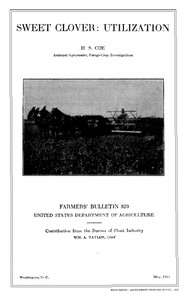
H. S. Coe's Sweet Clover: Utilization opens with a direct claim: sweet clover, when properly handled, will furnish as much nutritious pasturage as any other legume. The sentence structure is declarative and instructional, typical of early twentieth-century USDA bulletins. The voice is that of an expert addressing a farmer, using imperative constructions such as “it is very important that” and “care must be taken.” The bulletin’s language shifts between broad assertions—like the crop’s ability to support 20 to 30 hogs per acre—and precise technical details, such as the recommendation to have extension shoe soles made for the mower. This alternation creates a rhythm that moves from confident generalization to specific, actionable advice.
Instructional Imperatives and Conditional Warnings
The bulletin’s narrative voice relies heavily on conditional statements that anticipate farmer skepticism. For instance, Coe writes that stock “may refuse to eat sweet clover at first, but this distaste can be overcome by keeping them on a field of young plants for a few days.” The phrasing acknowledges a problem—the bitter coumarin taste—and immediately supplies a remedy. This pattern recurs throughout: “If the plants contain too much moisture it may be a good plan to mix some corn stover.” The language is not merely descriptive; it is prescriptive, often using “should” and “must.” Coe also warns against letting the plant show flower buds before cutting, and specifies stubble heights (10 to 12 inches) with a precision that suggests experience with failure. The conditional “if” clauses build a sense of caution, as in “if molding is to be avoided.” These linguistic choices reveal an author who expects resistance—both from the crop and from the reader.
Shifts in Pace: From General Statement to Tabular Data
The bulletin’s pace changes markedly when it moves from prose to tables. The opening sections on pasturage and hay are written in flowing paragraphs with broad yield estimates. But when discussing silage, the text slows to accommodate a table comparing sweet-clover silage with corn silage. The table’s rows list percentages of water, ash, crude protein, carbohydrates, and fat. Coe then interprets the data in a more measured tone: “As shown in Table III the analyses…compare favorably in food elements with corn silage.” The shift from imperative advice to analytical commentary alters the reader’s engagement—from following instructions to evaluating evidence. A similar deceleration occurs when Coe describes the loss of juice from silage, citing an analysis that showed 0.23 percent protein and 2 percent carbohydrates. These numeric details contrast with the earlier, more sweeping claims about acre yields, creating a rhythm of broad statement followed by fine-grained support.
Recurring Details: Overcoming Reluctance and Managing Moisture
Two concerns recur throughout the bulletin: livestock reluctance and moisture control. The language around reluctance is consistent: “stock may refuse,” “distaste can be overcome,” “stock seldom eat the hard, woody stems.” Coe returns to this theme in the section on palatability, attributing refusal to “the woody growth…and the bitter taste due to coumarin.” The repetition reinforces the idea that sweet clover requires careful introduction. Moisture appears as a problem in hay curing (“difficult…to cure the first crop”) and in silage making, where juice loss is addressed by wilting, adding corn stover, or soaking straw. The phrase “sufficient water” appears twice in the silage instructions, and the need to “tramp the straw thoroughly” to exclude air is emphasized. These recurring details—palatability and moisture—are not merely technical; they shape the bulletin’s argument that sweet clover’s value depends on precise handling. The voice remains consistently practical, never speculative.
Readers approaching this bulletin should attend to the interplay between Coe’s confident generalizations and his cautious, condition-laden instructions. The text is not a neutral description but a persuasive manual designed to convert skeptics. Noticing when the author shifts from imperative commands to data-driven analysis reveals the underlying argument: sweet clover is valuable, but only if managed correctly. The bulletin’s brevity—under 16,000 words—means every repetition and every table serves a rhetorical purpose. Treat the tables not as appendices but as moments where the voice changes tempo, grounding advice in evidence.
Reading this bulletin’s careful coaxing of reluctant livestock, I thought of my grandfather’s patient hands sorting pressed ferns last autumn. That same quiet insistence—an object resisting, then yielding to attention—lives in Notes on Collecting and Preserving Natural-History Objects — Key Ideas to Explore. Both speak of slow, practiced tenderness, the kind that turns hesitation into belonging.