About 112 minutes
The Almond in California — Background and Themes
Gardening
25,752 recorded words. 3 minutes difference from this book's estimate.
View Gutenberg source #66711
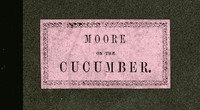
This digital edition of Theory and Practice, Applied to the Cultivation of the Cucumber in the Winter Season To Which Is Added a Chapter on Melons — Edition Insights is described by source-level measurements including 24,903 words, 1 hr 49 min estimated reading time, and 3 detected text sections.
The text analysis averages about 44.7 words per sentence, while the detected sections provide another way to judge how the source is divided.
Project Gutenberg metadata also associates the work with “Cucumbers,” connecting these edition facts with the source record’s subject description.
Explore this collection
These alternatives are selected using recorded categories and estimated reading time.
About 112 minutes
Gardening
25,752 recorded words. 3 minutes difference from this book's estimate.
View Gutenberg source #66711About 100 minutes
Gardening
22,849 recorded words. 9 minutes difference from this book's estimate.
View Gutenberg source #48547About 99 minutes
Gardening
22,603 recorded words. 10 minutes difference from this book's estimate.
View Gutenberg source #33679Search stored excerpts and compare books → Choose by your preferences →
Choices use stored catalog measurements. Estimates vary with reading speed. A shared category is a catalog label, not a claim that two books have the same argument or literary quality.
Search reads excerpt text stored with this catalog and links to its associated Gutenberg record. The connection is stored in the site database; this tool does not recheck that every excerpt is word-for-word identical to that external record. Excerpt search does not cover every chapter and does not verify historical publication dates.
Catalog snapshot checked: 2026-09-25. Coverage: 98 public books, 98 available source excerpts.
Read the complete public-domain text at its original source.
Read on Project GutenbergThomas Moore, a member of the Botanical Society of London, opens his second edition by stating that he has preserved the original text exactly and placed new material in an appendix. The preface to the first edition frames the book as an inducement to young gardeners to seek the reasons behind daily operations, warning that there is much to be unlearned in horticultural science. Moore insists that success does not depend on performing any part of cultivation at a particular time or in a superior manner, but on supplying all conditions necessary to plant nutrition and perpetuation.
Moore explicitly positions his work against empiricism, stating that direction should be sought in the open pathway of science, not the bye-ways of empiricism. He argues that the ultimate success of gardening operations depends on supplying in a natural manner all the conditions necessary for plant nutrition and perpetuation. This principle recurs throughout the excerpts: for example, when discussing temperature regulation, he warns that it is not always safe to supply a resemblance to natural circumstances unless one can supply the greater part or all of the conditions that exist in nature. The book thus consistently advocates for a holistic, science-based approach rather than rule-of-thumb practices.
A detailed passage on moisture describes a system where water can be poured beneath the soil onto a tank, rising as vapour to moisten the soil thoroughly, while surface watering can be applied separately. The atmosphere is moistened by ventilation that warms air and charges it with moisture in ratio to its temperature before it enters the house. Moore also provides for admitting moisture without changing the air volume, or for dry heat by closing the moisture reservoir. This precise engineering reflects his conviction that an equable degree of moisture beneath and among the soil, as well as in the atmosphere, can be secured with perfect ease and trifling labour.
Moore notes that the cucumber is a reputed native of the East, indicating the climate to be provided, but he immediately cautions that the standard of temperature in cultivation varies with individual opinion. Some cultivators take part of the natural conditions as their rule, others all circumstances, and others various combinations. He concludes that in clear sunny weather the temperature cannot within reasonable limits be permitted to rise too high, while in dull weather and at night a much lower temperature is appropriate. This nuanced view underscores his central argument: success depends on adjusting multiple factors in concert, not on any single fixed rule.
Moore's treatise is best read as a period argument for scientific horticulture, grounded in the author's own practical innovations. Readers interested in the history of gardening technology will find detailed descriptions of heating, watering, and ventilation systems. The appendix, added for the second edition, extends the original advice on transplanting, turf pots, and atmospheric humidity, making this a layered document of mid-nineteenth-century horticultural thought.
There’s something comforting in Moore’s insistence that we can’t force a cucumber into being, only tend its conditions. That same patient trust in hidden processes comes to mind when I think of the geysers in Wonders of the Yellowstone — Themes and Context — waiting underground, unprovable until they rise on their own schedule. I keep both books nearby, reminders that some things simply need their season.
Answer a few questions and save a private reflection on this device.