About 99 minutes
Seeds of Michigan Weeds — Key Ideas to Explore
Gardening
22,603 recorded words. 1 minutes difference from this book's estimate.
View Gutenberg source #33679
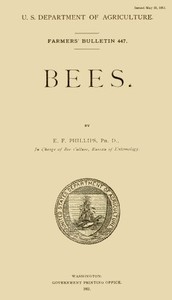
For Bees — A Closer Reading, the stored edition analysis reports 22,849 words, 1 hr 40 min estimated reading time, and 4 detected text sections.
The text analysis averages about 20.6 words per sentence, while the detected sections provide another way to judge how the source is divided.
Project Gutenberg metadata also associates the work with “Bees,” connecting these edition facts with the source record’s subject description.
Explore this collection
These alternatives are selected using recorded categories and estimated reading time.
About 99 minutes
Gardening
22,603 recorded words. 1 minutes difference from this book's estimate.
View Gutenberg source #33679About 97 minutes
Gardening
22,250 recorded words. 3 minutes difference from this book's estimate.
View Gutenberg source #3452About 95 minutes
Gardening
21,800 recorded words. 5 minutes difference from this book's estimate.
View Gutenberg source #43581Search stored excerpts and compare books → Choose by your preferences →
Choices use stored catalog measurements. Estimates vary with reading speed. A shared category is a catalog label, not a claim that two books have the same argument or literary quality.
Search reads excerpt text stored with this catalog and links to its associated Gutenberg record. The connection is stored in the site database; this tool does not recheck that every excerpt is word-for-word identical to that external record. Excerpt search does not cover every chapter and does not verify historical publication dates.
Catalog snapshot checked: 2026-09-25. Coverage: 98 public books, 98 available source excerpts.
Read the complete public-domain text at its original source.
Read on Project GutenbergE. F. Phillips's Bees, issued as Farmers' Bulletin 447 in 1911, opens with a letter of transmittal that frames the work as a revision of earlier bulletins, aiming to provide concise information for beekeepers. The text moves through a sequence of topics—from location and equipment to bee behavior, manipulations, and disease—each section building on the last. This structure mirrors the seasonal rhythm of beekeeping, with spring management, swarm control, and winter preparation forming a natural arc.
Recurring images of tools and hive components—smokers, veils, queen excluders, and drone traps—anchor the practical advice. The illustrations, such as the ten-frame hive with comb honey super (fig. 2) and the handling of frames (figs. 14–16), serve as visual guides that complement the step-by-step instructions. Phillips's voice is direct and authoritative, often using imperative verbs: “shake most of the bees,” “cut out queen cells,” “give plenty of ventilation.” This tone reinforces the bulletin's purpose as a manual for active management.
The bulletin's structure is itself a lesson in beekeeping logic. It begins with the apiary's location, then moves to equipment, then to the bees themselves—a progression from environment to tools to living subjects. Each chapter addresses a phase of the beekeeper's year: spring management, swarm control, harvest, winter preparation. The table of contents lists 22 sections, but the text flows through them with minimal interruption, using subheadings to mark transitions. Phillips often cross-references earlier sections, creating a web of interconnected advice. For instance, the discussion of artificial swarming (section on “Artificial Swarming”) explicitly links to the shaking treatment for diseases, showing how one manipulation serves two purposes. This structural economy reflects the bulletin's origin as a government publication meant to be both comprehensive and efficient.
The 19 figures in Bees are not decorative; they are functional diagrams that teach by showing. Figure 2 depicts a ten-frame hive with a comb honey super and perforated zinc queen excluder, labeling each part. Figures 14–16 demonstrate the three positions for handling a frame—a sequence that trains the reader in a safe, efficient technique. The smoker (fig. 3), bee veil (fig. 4), and hive tools (fig. 5) are drawn with enough detail to be recognizable but simplified to emphasize use. Phillips refers to these figures in the text, as when he mentions “the use of a drone trap (fig. 6)” or “a bee escape (fig. 7).” This integration of image and text creates a multimodal instruction set, where the reader must look back and forth between word and picture to fully grasp the manipulation.
Phillips's prose is dominated by action verbs that place the beekeeper in charge: “shake,” “cut,” “give,” “prevent,” “unite,” “feed.” The imperative mood is common, as in “give plenty of ventilation” or “cut out queen cells.” This linguistic choice reflects the bulletin's goal of empowering readers to manage their colonies actively. Even when describing bee behavior, Phillips frames it as something to be directed: “The bees may be prevented from leaving the hive by the use of a drone trap.” The text rarely speculates about bee psychology; instead, it offers cause-and-effect explanations: “crowded and overheated hives are particularly conducive to swarming.” This pragmatic language, combined with the frequent use of “should” (e.g., “should be under the control of the bee keeper”), creates a manual that is prescriptive without being dogmatic.
The bulletin shifts between macroscopic and microscopic views of beekeeping. Early sections discuss the apiary's location in terms of wind, sun, and water—landscape-scale considerations. Later, the text zooms in on the hive's interior, describing the arrangement of frames and the use of queen excluders. At the finest scale, Phillips examines comb architecture (fig. 11) and the life stages of bees (fig. 12: egg, larva, pupa). This movement between scales is not arbitrary; it mirrors the beekeeper's own attention, which must range from the field of flowers to the individual cell. The illustrations reinforce this: figure 10 shows worker, queen, and drone at actual size, while figure 11 magnifies the comb's hexagonal cells. By alternating between these perspectives, Phillips trains the reader to think simultaneously about the whole colony and its smallest components.
Readers approaching Bees should attend to its dual nature: it is both a practical handbook and a document of early twentieth-century agricultural science. The bulletin's structure, with its clear headings and cross-references, rewards sequential reading, but its sections can also be consulted independently for specific tasks. Pay particular attention to the figures, which often contain details omitted from the text. Phillips's language, though plain, carries assumptions about the beekeeper's role as an active manager—a perspective that shapes every recommendation.
In all my years shelving quiet companions, I’ve noticed how Bees — A Closer Reading tends to linger near the garden window, its careful diagrams murmuring of patient labor. Beside it, though, I keep a heavier, older friend — The art of promoting the growth of the cucumber and melon in a series of directions for the best means to be adopted in bringing them to a complete state of perfection — Inside the Classic — both of them whispering the same unhurried secret: every thriving thing waits for a hand that understands its seasons.
A brief reflection can help important ideas stay with you longer.