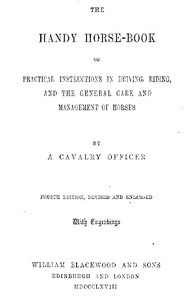
Maurice Hartland Mahon, writing under the pseudonym “Magenta,” draws on his experience as a cavalry officer, hunting horseman, and coach proprietor to produce a manual that is notably skeptical of theoretical knowledge. The book’s fourth edition opens with press opinions praising its practical, condensed advice, and the author’s own preface likely reinforces his intent to make horse owners independent of ignorant farriers and grooms. The excerpts reveal a writer who values firsthand observation and is willing to describe specific, sometimes unorthodox, techniques for managing equine behavior.
Handling Shyness Without Force
Mahon’s advice on a horse that shies at an object reveals a nuanced understanding of equine psychology. He recommends against forcing the animal’s head toward the offending object while in motion, calling that “bad horsemanship” and “dangerous.” Instead, he suggests bringing the horse to a standstill and allowing it to approach gradually, using its nose and lips to investigate. He explicitly condemns punishment by whip or spur—what he calls “cramming” the horse up to a thing—as “a vile error.” This emphasis on patience and sensory reassurance contrasts with the more coercive methods common in some contemporary manuals.
For a horse that persistently bolts and turns at a particular spot, Mahon proposes a clever reversal: let the animal have its way, and keep turning it until it becomes tired of the game and willingly goes forward. This tactic, which he describes as taking the horse “at his own fancy,” shows a willingness to outwit rather than overpower. He also notes that a horse’s acute sense of smell can cause shying at a unseen dead animal, a detail that grounds his advice in observed equine behavior.
Selling: Practical Market Strategy
Mahon’s section on selling horses is brisk and unsentimental. He distinguishes between a “fancy” animal—one with beauty, action, or disposition that commands a premium—and an “ordinary useful class” horse. For the former, he advises seeking a “fancy customer” through time and attention, while for the latter he recommends immediate disposal via public auction, fair, or private sale. He endorses the auction as “the readiest and least troublesome mode” for unsuitable property, but cautions that the owner should set a reasonable, rather low reserve price and ensure the sale is well attended.
He warns against exhibiting an animal out of condition, stating bluntly that “it always pays to make your horse look as well as possible before he meets the eye of a customer.” The old saying he quotes—“no meat sells so well as horse meat”—underscores his pragmatic, market-oriented approach. This section is free of romanticism about the horse as a noble beast; instead, it treats the animal as a commodity to be presented and sold efficiently.
Caprice and the Individual Mount
Mahon acknowledges that even the best riders feel diffidence when starting with a new mount, and he devotes a section to the whimsical nature of horses. He recounts a personal anecdote about a hunter named Baronet, which he purchased after seeing it perform excellently in the field. The horse soon revealed a peculiarity: it would refuse to go through any street it did not choose, walking on its hind legs when its will was disputed. Mahon’s solution was to drop the reins and gently direct the horse with the point of the whip at the side of its nose, after which the animal went “as quiet as a sheep.”
This story illustrates Mahon’s belief that a horseman who “identifies himself with his steed” can sometimes hit upon the means of managing a capricious animal “by a mere fluke.” He does not claim universal methods but rather emphasizes the importance of observation and adaptability. The anecdote also shows his willingness to share a personal failure (the horse’s prior reputation for this behavior was unknown to him) and his inventive, non-confrontational resolution.
Diction and Voice: The Cavalry Officer’s Prose
Mahon’s writing is direct and unpretentious, favoring concrete nouns and active verbs. He uses the first person sparingly but effectively, as in the Baronet anecdote, and addresses the reader as “you” or “the owner.” His sentences are often short and imperative: “Punishment by whip or spur … is a vile error.” He employs colloquial phrases like “cramming him up to a thing” and “a very unseating sort of a shy,” which lend a conversational, experienced tone. Technical terms are explained in context, and he avoids jargon for its own sake.
The press opinions quoted at the front of the book highlight this quality: the Athenæum notes that he “propounds no theories, but embodies in simple and untechnical language what he has learned practically.” The Sporting Gazette adds that “there is scarcely a single sentence which does not convey sound and valuable information.” Mahon’s prose reflects his stated goal of making horse owners independent of farriers and grooms, and his voice is that of a knowledgeable practitioner rather than a distant expert.
Mahon’s manual rewards a reader interested in the practical, day-to-day decisions of a nineteenth-century horse owner. His advice is specific enough to be tried, and his anecdotes offer glimpses of the relationship between rider and mount that go beyond mere instruction. Readers should note that the excerpts are incomplete; the full book likely covers additional topics such as driving techniques, stable management, and equipment. Approach the text as a period artifact of equestrian practice, one that values experience over theory and individual observation over general rules.
There’s a quiet comfort in a book that assumes you already love something enough to fuss over it, whether that’s a nervous horse or a stubborn hillside. The old officer’s patience with capricious mounts reminds me of a similar gentleness I found while reading Making a Rock Garden — A Reader’s Guide, where stones, too, seem to have moods worth respecting.