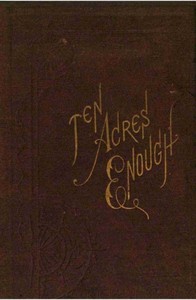
Edmund Morris opens his 1864 work with a direct challenge to the prevailing agricultural ambition of his era: the desire to own more land than one can properly manage. He identifies this as 'the great agricultural sin of this country,' a phrase that sets the tone for a book that is as much a moral argument as a practical guide. Morris writes not for established farmers but for 'patient toilers in city, town, and village' who dream of escaping the desk or counter for a modest, secure rural life. His preface establishes a clear rhetorical stance: small acreage, when intensively cultivated, can yield a sure income and a refuge from economic upheaval.
A Voice of Practical Experience
Morris's narrative voice is that of a self-taught experimenter, not a distant expert. He repeatedly grounds his advice in personal trial: he describes his own mistakes, such as initial overconfidence in soil quality, and the adjustments he made. This first-person, anecdotal style gives the text an intimate, persuasive quality. For instance, he recounts shooting a yellow-bird to examine its crop, finding two hundred weevils and only four grains of wheat—a lesson he calls 'worth the life of the poor bird.' Such episodes reveal a writer who values evidence over hearsay, and who is willing to admit error in the service of a larger truth. His voice is earnest, occasionally moralizing, but always anchored in concrete detail.
Shifts in Pace: From Instruction to Observation
The book's rhythm alternates between brisk, instructional passages and slower, observational set pieces. Early chapters on soil preparation and planting move at a practical, step-by-step pace, with lists of expenses and yields. Later, Morris lingers over scenes like the rescue of a trapped warbler, describing the 'crowd of sympathizing birds' and the family called out to witness the spectacle. This shift in tempo—from the hurried logic of profit and loss to the unhurried wonder of natural observation—reflects Morris's broader argument: that careful attention to small details, whether in the garden or the bird's nest, yields both material and spiritual rewards. The pace slows deliberately to allow the reader to see what Morris sees.
Recurring Details: Birds as a Measure of Wisdom
Birds appear throughout the excerpts as a recurring motif, serving both as practical allies and as moral exemplars. Morris devotes considerable space to defending them against farmers who see them as pests. He cites a neighbor who wanted to shoot 'yellow-birds' in his wheat, only to learn that their crops contained mostly weevils. He then offers a calculation: a single pair of birds might destroy a thousand worms in eight hours, and a hundred pairs could eliminate three million insects a month. This blend of anecdote and arithmetic is characteristic of Morris's method. The bird episodes also carry a philosophical weight: they illustrate his belief that nature is 'better contrived for him than he can contrive them for himself,' a lesson in humility and observation.
Readers approaching Ten Acres Enough should attend to the interplay between Morris's practical advice and his reflective interludes. The book rewards those who read slowly, noting how the author's own learning curve shapes the narrative. His voice is that of a pioneer in small-scale agriculture, but also of a man who found in his ten acres a school for patience and precision. The text is best read as a companion to one's own garden, not as a rigid blueprint.
Over the years I’ve watched Ten Acres Enough gather dust, its quiet arithmetic of soil forever waiting. These practical books share a gentle communion. Both trust the patient eye and the careful season—one measures by the furrow, the other by the hive's soft hum. I find myself lingering over The Bee-keeper's Manual or Practical Hints on the Management and Complete Preservation of the Honey-bee. — Inside the Classic, its pages whispering the same old truth—that small, steady attention keeps much thriving.