About 223 minutes
Devonshire — Story, Setting & Ideas
Gardening
51,243 recorded words. 6 minutes difference from this book's estimate.
View Gutenberg source #44738
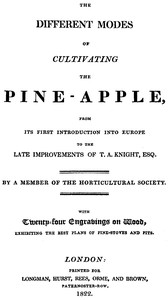
Before opening The different modes of cultivating the pine-apple From its first introduction into Europe to the late improvements of T.A. Knight, esq. — Context and Discussion, the edition data offers a quick orientation: 49,832 words, 3 hr 37 min estimated reading time, and 6 detected text sections.
The text analysis averages about 30.6 words per sentence, while the detected sections provide another way to judge how the source is divided.
Project Gutenberg metadata also associates the work with “Pineapple,” connecting these edition facts with the source record’s subject description.
Explore this collection
These alternatives are selected using recorded categories and estimated reading time.
About 223 minutes
Gardening
51,243 recorded words. 6 minutes difference from this book's estimate.
View Gutenberg source #44738About 226 minutes
Gardening
51,763 recorded words. 9 minutes difference from this book's estimate.
View Gutenberg source #51477About 226 minutes
Gardening
51,812 recorded words. 9 minutes difference from this book's estimate.
View Gutenberg source #76043Search stored excerpts and compare books → Choose by your preferences →
Choices use stored catalog measurements. Estimates vary with reading speed. A shared category is a catalog label, not a claim that two books have the same argument or literary quality.
Search reads excerpt text stored with this catalog and links to its associated Gutenberg record. The connection is stored in the site database; this tool does not recheck that every excerpt is word-for-word identical to that external record. Excerpt search does not cover every chapter and does not verify historical publication dates.
Catalog snapshot checked: 2026-09-25. Coverage: 98 public books, 98 available source excerpts.
Read the complete public-domain text at its original source.
Read on Project GutenbergJohn Claudius Loudon opens his 1822 treatise by positioning pineapple cultivation as a matter of intense horticultural interest, specifically citing the experiments of T. A. Knight. Rather than offering a single method, Loudon proposes to compile all known European approaches, drawing on published works and his own observations of successful gardeners. The introduction lists British treatises from 1767 onward, naming Giles, Taylor, Speechly, Griffin, and Baldwin, and dismisses most foreign publications as 'of little value'—a blunt assessment that sets a practical, evaluative tone.
Loudon’s method is bibliographic as much as horticultural. He surveys British works from John Giles (1767) through Thomas Baldwin (1818), noting each author’s affiliation—Speechly was gardener to the Duke of Portland, Griffin to J. C. Girardot—and ranks them by utility. Foreign sources are dismissed curtly: French authors Thouin and Bosc appear only in general dictionaries, and Kirchner’s 1796 German manual is the sole dedicated continental work. This selective catalog reveals Loudon’s conviction that British practice, especially the hothouse management of pine-stoves and bark-beds, had outstripped European rivals.
The excerpted potting instructions shift from Loudon’s editorial voice to a first-person practitioner’s account, likely drawn from a named gardener. The writer insists on a gravel layer at the pot’s bottom, two inches thick in small pots and three to four in larger ones, to drain excess moisture. He observes that roots ‘delight in gravel,’ pushing strong fibres into it, and prefers sea-gravel containing shells for its porosity. The passage is dense with tactile detail: ‘trindle in the mould with a small, blunt-pointed, wedge-shaped stick,’ ‘shake the pot well on a bench or table.’ Such instructions convey a hands-on, iterative craft, not abstract theory.
The seasonal rhythm of potting is laid out with precision. In May, plants are shifted into six-inch pots without shaking out the root ball; only matted fibres at the bottom are singled out. By November, only those plants whose roots have filled their pots are moved to the next size, keeping balls entire. Dead leaves are trimmed from the stem’s base, and old mould is replaced on the surface. The spacing changes from eight or nine inches between centres in small pots to fifteen inches for larger ones. Watering is minimal until the bark-bed heat rises to the pots—a rule that ties every action to the temperature of the growing environment.
Throughout the excerpts, bottom heat from a bark-bed is treated as the decisive factor. The gardener claims that a mild bottom-heat, combined with the gravel drainage layer, matters more than ‘all the other rules that have been given respecting them, out of the ordinary way.’ Plants are plunged to the pot rims, kept level, and watered with aired water only after the heat rises. The insistence on ‘mild’ heat—avoiding violent heat that might damage roots—reflects a nuanced understanding of the stove environment. Loudon’s compilation thus preserves not just techniques but the conditional reasoning behind them.
Loudon’s book is best read as a reference work in dialogue with itself: the introduction frames it as a survey, but the extracted passages read like a master gardener’s notebook. Readers interested in historical horticulture will find value in the specific ratios—two inches of gravel, fifteen-inch spacing—and in the way Loudon lets practitioners speak at length. The treatise does not argue for one best method; it assembles evidence, leaving the cultivator to judge.
Reading about the patient, repeated experiments with bark-beds and gravel drainage, I remembered my grandfather’s greenhouse—the smell of damp soil, the slow wait for a single ripening fruit. It felt like the first time I read Peter Parley's Wonders of the Earth, Sea, and Sky — A Closer Reading, where wonder crept in through quiet, factual detail rather than grand pronouncements. Both books made patience feel like a form of attention.
Use these questions to collect your thoughts before moving on.