
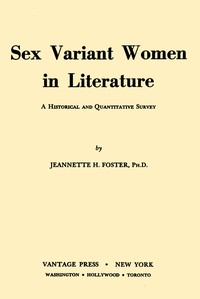
Sex variant women in literature : A historical and quantitative survey by Foster
If you think LGBTQ+ literary history started with Stonewall, Jeannette Foster's 1956 book will completely change your perspective. This isn't a novel; it's a massive, scholarly survey. Foster, a librarian with a sharp mind, set out to do something radical for her time: systematically find and catalog every instance of what she called 'sex variant' women—women who loved women—in Western literature, from ancient times up to the mid-20th century.
The Story
Think of Foster as a literary archaeologist. She didn't just offer opinions; she gathered evidence. She read everything, from Sappho's fragments to obscure French novels, and organized her findings. The book shows how portrayals of these women shifted over time. In some eras, their love was celebrated in poetry. Later, it became a tragic flaw or a sign of madness in novels. Foster tracks these changing attitudes, showing how literature both mirrored and enforced society's views. The 'plot' is the journey of these characters through history, and the tension comes from seeing how their stories were told, hidden, or condemned.
Why You Should Read It
This book is powerful because of its sheer conviction. In the conservative 1950s, Foster insisted these women's stories mattered and deserved serious study. Her tone is calm and academic, but her project was revolutionary. Reading it, you feel the weight of her research. You see the patterns emerge—the same fears, the same stereotypes, repeating for centuries. It gives you a new lens for reading almost any classic. Suddenly, you might see a 'close friendship' in a Jane Austen novel or a 'tragic heroine' in a French story in a completely new light. It connects dots across history in a way that feels genuinely exciting.
Final Verdict
This is essential reading for anyone interested in LGBTQ+ history, feminist literary criticism, or the history of sexuality. It's a cornerstone text. Be warned: it's a dense, scholarly work, not a breezy read. But if you're a curious reader who loves digging into the context behind the stories we tell, this book is a treasure map. It's for the reader who finishes a classic and wonders, 'What stories are we missing? Who wasn't allowed to speak?' Foster gives those hidden voices a history, and in doing so, she helped change the future of literary study.
No rights are reserved for this publication. Enjoy reading and sharing without restrictions.
Robert Taylor
4 months agoThe clarity of the introduction set high expectations, and the cross-referencing of different chapters makes it a great study tool. It cleared up a lot of the confusion I had previously.
Matthew White
7 months agoThe layout is perfect for tablet and e-reader devices.
Paul Johnson
1 year agoIt effectively synthesizes complex ideas into a coherent whole.





Patricia Gonzalez
1 year agoThis digital copy caught my eye due to its reputation, the logic behind each conclusion is easy to follow and verify. This is a solid reference for both beginners and experts.