
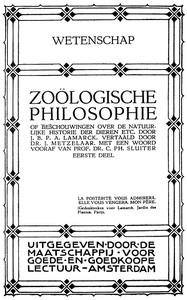
Zoölogische Philosophie by Jean Baptiste Pierre Antoine de Monet de Lamarck
Let's be clear: this isn't a novel with a plot. It's a scientific manifesto, but one with a dramatic story baked right into its pages. The 'story' here is the argument Lamarck builds, brick by brick, against the static view of nature that dominated his time.
The Story
Lamarck looks at the animal kingdom and sees a story of transformation. He proposes two big, driving forces. First, life has a natural tendency to become more complex over vast stretches of time, moving up a 'ladder' of being. Second, and this is his famous (and infamous) idea, animals adapt to their environment through use and disuse. He argues that if an animal constantly uses an organ—like a mole digging with its paws—that organ strengthens and changes across its lifetime. Then, crucially, he believed those acquired traits could be passed on to its offspring. It's a theory of effort and inheritance. The entire book is his case for this fluid, dynamic world, classifying animals not as fixed types, but as points in a grand, ongoing process of change.
Why You Should Read It
Reading Lamarck today is a weirdly moving experience. You're not reading for 'correct' facts. You're reading for the sheer audacity of the thought. His writing crackles with the excitement of seeing connections no one else did. When he describes how environments shape creatures, you feel his wonder. Sure, we now know the mechanism of heredity is different, but his core insight—that species change and that environment is the engine—was revolutionary. It's like listening to a brilliant musician play a masterpiece on an instrument that's slightly out of tune. The melody of the idea is still beautiful and powerful. It makes you appreciate Darwin's later work not as a brand-new idea, but as a correction and refinement of a path Lamarck boldly carved.
Final Verdict
This book is perfect for curious minds who love the history of ideas. If you enjoy science, you'll get a front-row seat to one of its greatest 'wrong turns' that was actually full of right thinking. It's for readers who don't just want the answer, but want to walk the messy, fascinating path that led to it. It's not an easy beach read, but for anyone who's ever wondered 'how did we figure that out?', Lamarck's passionate, flawed, and groundbreaking philosophy is an essential and thrilling chapter.
This content is free to share and distribute. Use this text in your own projects freely.
Amanda Martin
4 months agoGood quality content.
Emily Thompson
3 months agoIt effectively synthesizes complex ideas into a coherent whole.