About 277 minutes
The Busy Woman's Garden Book — Edition Insights
Gardening
63,676 recorded words. 4 minutes difference from this book's estimate.
View Gutenberg source #56001
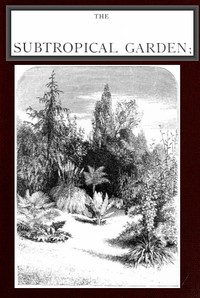
This digital edition of The Subtropical Garden; or, beauty of form in the flower garden. — Inside the Classic is described by source-level measurements including 62,690 words, 4 hr 33 min estimated reading time, and 10 detected text sections.
The text analysis averages about 17.5 words per sentence, while the detected sections provide another way to judge how the source is divided.
Project Gutenberg metadata also associates the work with “Gardening,” connecting these edition facts with the source record’s subject description.
Explore this collection
These alternatives are selected using recorded categories and estimated reading time.
About 277 minutes
Gardening
63,676 recorded words. 4 minutes difference from this book's estimate.
View Gutenberg source #56001About 278 minutes
Gardening
63,762 recorded words. 5 minutes difference from this book's estimate.
View Gutenberg source #2355About 258 minutes
Gardening
59,291 recorded words. 15 minutes difference from this book's estimate.
View Gutenberg source #62982Search stored excerpts and compare books → Choose by your preferences →
Choices use stored catalog measurements. Estimates vary with reading speed. A shared category is a catalog label, not a claim that two books have the same argument or literary quality.
Search reads excerpt text stored with this catalog and links to its associated Gutenberg record. The connection is stored in the site database; this tool does not recheck that every excerpt is word-for-word identical to that external record. Excerpt search does not cover every chapter and does not verify historical publication dates.
Catalog snapshot checked: 2026-09-25. Coverage: 98 public books, 98 available source excerpts.
Read the complete public-domain text at its original source.
Read on Project GutenbergW. Robinson opens The Subtropical Garden by challenging the prevailing fashion for flower gardens dominated by masses of brilliant color, which he argues erases all beauty of form. His guiding aim is to select plants with large, graceful, or remarkable foliage—not necessarily from subtropical climates—and to associate them with low-growing flowering plants. The book is structured as a practical catalogue, but its preface and plant entries reveal a consistent argument: that a garden should be composed with an eye to shape, texture, and architectural presence, not merely a palette of hues.
Robinson’s method is as much about exclusion as inclusion. He explicitly rejects plants that earlier authors had recommended, such as Alnus glandulosa aurea and Ulmus campestris aurea (a form of common elm), arguing that if these are admissible, almost any species would be. This critical stance runs through the book: each entry weighs a plant’s suitability for the subtropical garden, often noting where it fails to meet the standard of grace or distinctness. For instance, Dracæna australis is described as useful but “not quite so graceful” as D. indivisa. The result is a curated list, not a mere compendium.
A recurring structural pattern in the plant descriptions is the movement between conservatory, greenhouse, and open garden. Robinson frequently notes that a species “may be used out of doors in summer” or “thrives best indoors.” Dracæna Draco, for example, is said to be “fine indoors at all seasons” yet can be placed in the open air from May to October in southern counties. This seasonal shuttling between protected and exposed settings is a practical rhythm that shapes the gardener’s year. The book thus functions as a guide to orchestrating a sequence of placements, not just a static planting plan.
Robinson’s descriptive vocabulary returns repeatedly to a few key qualities: grace, distinctness, and tropical-looking effect. Dracæna indivisa is praised for its “tropical-looking grace,” with leaves “from 2 ft. to 4 ft. long, tapering to a point, pendent, and dark green.” The Dracæna cannæfolia has leaves “rolled inwards, so as to form a kind of pipe, of a fine sea-green colour.” These visual details—pendent tips, rolled leaf margins, sheathing bases colored red or purple—are the building blocks of Robinson’s aesthetic. He is not content with botanical description; he evaluates each plant’s contribution to a composed picture of form and texture.
Robinson treats hardiness as a matter of degree and location, not a fixed property. Dracæna indivisa is “perfectly hardy in the south of England and Ireland,” but he notes that it stood out in a vase for several years at Muswell Hill, north of London. The Dracæna Draco is seldom seen more than 10 ft. high in England, though in the Canary Islands it attains great height and age. These observations ground the book in specific geography and microclimate, reminding the reader that the subtropical garden is a regional experiment, not a universal formula. Robinson’s evidence comes from gardens he has seen—Bicton, Woodstock, Muswell Hill—not from abstract theory.
Robinson’s book is best read as a working document: a set of judgments refined by observation, not a definitive encyclopedia. The reader should attend to the reasons given for inclusion or rejection, and to the seasonal movements between house and garden that structure each plant’s life. The illustrations mentioned in the list of contents are absent from this digital edition, but the text itself offers a vivid sense of leaf shapes, colors, and habits. For those planning a garden, the book provides a critical framework rather than a simple shopping list.
Holding The Subtropical Garden, I remembered my grandfather’s clipping-strewn bench, where form mattered more than flash. His quiet patience with leaf and stem felt like the old wonder I found while slowly tracing the world’s shapes in Peter Parley's Wonders of the Earth, Sea, and Sky — A Closer Reading, both books whispering that looking carefully is its own quiet adventure.
Use these questions to collect your thoughts before moving on.