About 761 minutes
The Desert World — A Closer Reading
Gardening
174,900 recorded words. 95 minutes difference from this book's estimate.
View Gutenberg source #43396
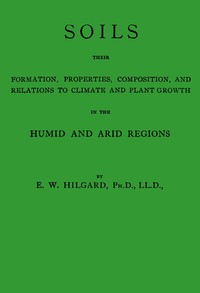
This digital edition of Soils, their formation, properties, composition, and relations to climate and plant growth in the humid and arid regions — Key Ideas to Explore is described by source-level measurements including 196,752 words, 14 hr 16 min estimated reading time, and 49 detected text sections.
The text analysis averages about 22.1 words per sentence, while the detected sections provide another way to judge how the source is divided.
Project Gutenberg metadata also associates the work with “Soils,” connecting these edition facts with the source record’s subject description.
Explore this collection
These alternatives are selected using recorded categories and estimated reading time.
About 761 minutes
Gardening
174,900 recorded words. 95 minutes difference from this book's estimate.
View Gutenberg source #43396About 529 minutes
Gardening
121,649 recorded words. 327 minutes difference from this book's estimate.
View Gutenberg source #51764About 501 minutes
Gardening
115,090 recorded words. 355 minutes difference from this book's estimate.
View Gutenberg source #26492Search stored excerpts and compare books → Choose by your preferences →
Choices use stored catalog measurements. Estimates vary with reading speed. A shared category is a catalog label, not a claim that two books have the same argument or literary quality.
Search reads excerpt text stored with this catalog and links to its associated Gutenberg record. The connection is stored in the site database; this tool does not recheck that every excerpt is word-for-word identical to that external record. Excerpt search does not cover every chapter and does not verify historical publication dates.
Catalog snapshot checked: 2026-09-25. Coverage: 98 public books, 98 available source excerpts.
Read the complete public-domain text at its original source.
Read on Project GutenbergHilgard opens with a definition of soils and a table of the earth's crust composition, then immediately moves to physical processes of soil formation. The early chapters systematically cover weathering, rock types, and mineral ingredients, establishing a methodical, evidence-based approach. Readers encounter a blend of geology, chemistry, and climatology from the start.
The excerpt on trade winds and cyclones illustrates Hilgard's attention to large-scale atmospheric processes. He explains how equatorial heating drives northeast and southeast trade winds, while descending air in temperate zones produces prevailing westerlies. Cyclones and anti-cyclones are described with their rotational directions and typical paths across North America, moving from west to east at twenty to thirty miles per hour. This discussion grounds soil formation in observable weather phenomena, linking wind-driven erosion and moisture transport to regional soil characteristics. Hilgard notes that topography modifies these general rules, foreshadowing his later treatment of arid and humid contrasts.
Hilgard emphasizes that mountain chains force moist air to rise, cool, and deposit rain on windward slopes, while leeward regions become arid. He cites the Great Basin between the Sierra Nevada and Rocky Mountains as a prime example. Conversely, the Mississippi-to-Atlantic region receives abundant rainfall because no cross-ranges block Gulf of Mexico moisture. These concrete geographic references allow readers to connect soil moisture regimes to specific landscapes. The discussion prepares for later chapters on irrigation and alkali soils, where aridity directly shapes soil chemistry and agricultural potential.
The chapter summaries reveal a progression: after physics and chemistry, Hilgard turns to soils and native vegetation. Chapters XXIV–XXVI focus on recognizing soil character from plant life, with separate treatments for Mississippi, the broader United States, and saline or alkali lands. This shift from laboratory analysis to field observation reflects the book's practical aim. Readers can anticipate that later sections will use tree species, grasses, and salt-tolerant plants as clues to soil type, a method Hilgard likely developed through his California experience. The vegetation chapters promise a synthesis of earlier material on climate and soil composition.
The table of contents shows four main parts: origin and formation, physics, chemistry, and soils-vegetation relations. Each part contains multiple chapters, with the chemistry section including detailed analysis of arid vs. humid soils and alkali reclamation. The book's 196,752 words and 49 sections indicate exhaustive coverage. Hilgard's preface and introduction set a scientific tone, citing Clarke's table of earth's crust composition. Readers should expect a systematic reference work rather than a narrative, with each chapter building on previous ones. The 1906 publication date places it in an era of expanding agricultural science, before modern soil taxonomy.
Hilgard's work rewards readers who move between its parts: the climate discussion illuminates the vegetation chapters, and the chemistry of alkali soils connects to topographic effects on rainfall. Treat the book as a layered reference—dip into sections based on your interest, but note how each chapter draws on earlier principles. The index and detailed chapter summaries help navigate this dense but coherent volume.
After a lifetime among these shelves, I find myself returning to Hilgard’s patient study of soils, where every landscape quietly writes its own story. That same hush dwells in the limestone shadows of the Cave Regions of the Ozarks and Black Hills — Background and Themes. Both speak of the earth’s slow memory, holding moisture and darkness with equal tenderness. An old kinship, indeed.
Use these questions to collect your thoughts before moving on.