
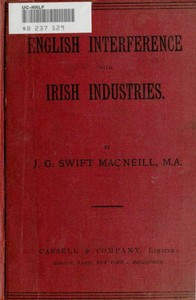
English Interference with Irish Industries by J. G. Swift MacNeill
Let's be clear from the start: this isn't a novel. There's no protagonist in the traditional sense. Instead, the 'story' here is the economic history of Ireland from the 17th to the 19th centuries, told as a narrative of loss.
The Story
MacNeill structures his book like a legal brief. He picks key Irish industries—woolen manufacturing, glassmaking, shipping, and others—and walks us through their rise and fall. For each one, he points to specific acts of the English Parliament. He shows how laws were passed that taxed Irish goods out of competition, banned exports to foreign markets, or outright prohibited certain manufacturing in Ireland to protect English businesses. The story he tells is one of a promising domestic economy being deliberately constrained and broken down, piece by piece, over centuries. The conflict is between Irish entrepreneurial spirit and English legislative power.
Why You Should Read It
What makes this book stick with you is its sheer conviction. MacNeill isn't a detached academic; he's a political figure writing with a clear purpose. You can feel his frustration and passion on every page. It transforms a list of historical facts into a powerful argument. Reading it, you start to see the modern Irish economic landscape not as an accident, but as a direct result of these calculated policies. It provides crucial context for understanding the social and political tensions that defined the era. It’s a masterclass in connecting dry policy to real human consequence.
Final Verdict
This book is perfect for history buffs who want to go beyond kings and battles and understand the economic engines of conflict. It’s also great for anyone interested in Irish history, colonialism, or the long-term impact of trade policy. Be warned: it’s a primary source from 1886, so the language is formal, but MacNeill's fiery rhetoric keeps it engaging. It’s not a light read, but it’s a profoundly illuminating one. You’ll finish it with a much clearer picture of why history unfolded the way it did.
This digital edition is based on a public domain text. Access is open to everyone around the world.
William Thompson
2 months agoI stumbled upon this title during my weekend research and the structural organization allows for quick referencing of key points. I'll be citing this in my upcoming project.
Robert Moore
6 months agoUnlike many other resources I've purchased before, the objective evaluation of the pros and cons is very refreshing. I'm glad I chose this over the other alternatives.
Karen Anderson
8 months agoGreat value and very well written.
Emily Miller
11 months agoThe digital formatting makes it very easy to navigate.





Paul Harris
6 months agoClear, concise, and incredibly informative.